How, from contemporary art to cinema to photography, artists immortalize the passing of time. Article on Slate.fr

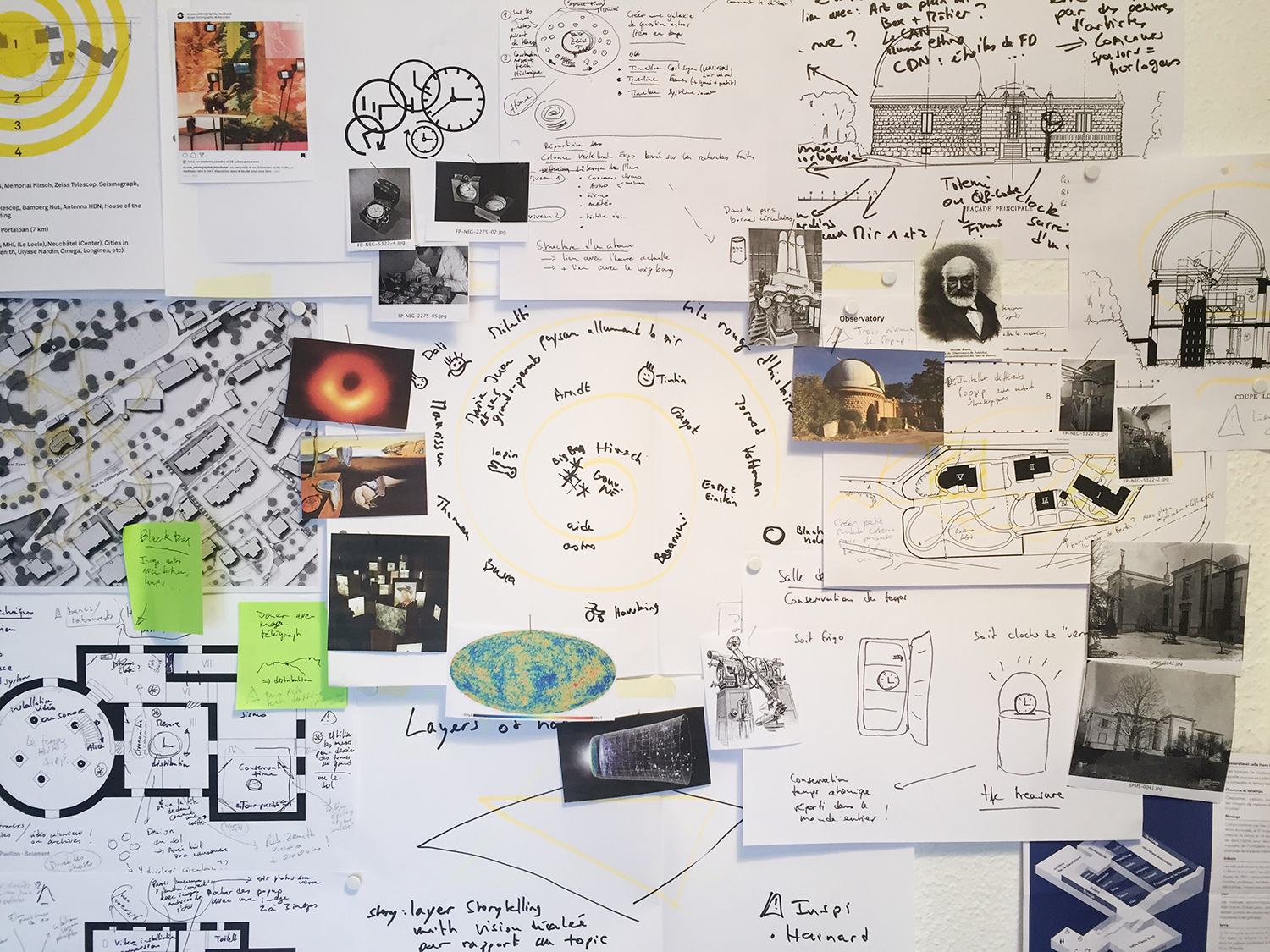
Space and Time. Stories from the Neuchâtel Observatory
HKB MA Design Entrepreneurship – Exhibition Project
How, from contemporary art to cinema to photography, artists immortalize the passing of time. Article on Slate.fr
Femke Herregraven investigates which material base, geographies, and value systems are carved out by financial technologies and infrastructures. Her work focuses on the effects of abstract value systems on historiography and individual lives. This research is the basis for the conception of new characters, stories, objects, sculptures, sound and mixed-media installations. Her current work focuses on the financialization of the future as a ‘catastrophe’ and uses language, the voice and the respiratory system to examine these monetized speculative catastrophes within our social, biological and technological ecosystems.
She taught at Artez Arnhem and the Gerrit Rietveld Academie and is an alumnus of the Rijksakademie van beeldende kunsten in Amsterdam (2017–2018). In 2016, she collaborated with Dutch investigative journalist on the Panama Papers. She is currently part of On-Trade-Off (2018–2021): an artist-run experimental research project on lithium. In 2019, she was nominated for the Prix de Rome. She is currently a Creator Doctus (practice-based PhD) candidate at Sandberg Instituut (2020–2023)

Salvador Salort-Pons
Original article on The Detroit News | Dec 15, 2019
When I began my career as a curator, museums were viewed as organizations that collected, preserved, displayed, and researched works of art, then educated the visitor about the information emerging from that work. The art object was the center of the museum’s focus, and the facts related to it helped write the narrative of our artistic culture.

Over time, particularly in recent years, cultural organizations such as museums and libraries have strengthened their relevance in our society. They are the keepers of our history and culture, and through scholarly research and interpretation they help shape our social identity, an authentic point of reference that people can trust.
But museums are becoming more than just buildings that house art collections and their associated factual information. Through permanent collections and a variety of cultural programs and exhibitions, ranging from the DIA’s current exhibition, Star Wars™ and the Power of Costume, to the Detroit Historical Museum’s award-winning community-based work on the Detroit ’67 project, museums are evolving into places to gather and share human experiences. They are establishing themselves as community builders that emphasize our rich, diverse cultures as a bonding medium for our society. Their collections are becoming mirrors where diverse communities seek to be represented and reflected, culturally and individually.
Scholarly research and conservation are the bedrock from which we start to build. Collections are a launching point to present and discuss matters with which communities wrestle, or by which they are inspired or simply enjoy. In the museum space, we welcome opportunities to hear multiple perspectives, the different views of the world that emerge from experiencing our art collection and the meanings that they spark for individuals.
Arts organizations can help our citizens develop critical thinking and creative skills so they are better prepared for their lives. Moreover, understanding how others think, learning how to listen, and creating a space for empathy, energized by the power of art, are some of the greatest opportunities museums can offer our audiences.
In our daily work, we must go beyond the walls of our buildings. We establish lines of dialogue with our communities, deepening our relationships with them and generating authentic bonds, as we serve them with programs that resonate with their interests while maintaining a museum-quality product. The result is an environment of trust and unity in which our society can thrive. Museums are places where we connect our past and present, build trust, inspire and envision a hopeful future.
Salvador Salort-Pons is director, president and CEO of the Detroit Institute of Arts.
“Paul Virilio : Thinking Speed” a film by Stéphane Paoli (documentary 90 min / 2008 / La Générale de Production / ARTE France) In an unprecedented way, this dazzling story of Paul Virilio’s thought confronts the reflections of philosophers, political actors and journalists such as Rifkin, Yunus, Bender, Klein, Jean Nouvel.
“If time is money, speed is power…”
Progress and catastrophe are the obverse and reverse sides of the same coin (…) To invent the train is to invent the derailment, to invent the plane is to invent the crash (…) there is no pessimism in this, no despair, it is a rational phenomenon (…), masked by the propaganda of progress.
Jim Richardson
Original paper on MuseumNext >

Is your museum looking to get donations online? Are you looking for a WordPress donation plugin?
With the current crisis hitting museum finances, institutions are looking at how they can raise funds online. In this article, we will share fundraising and donation plugins that can help your museum to collect one off and recurring donations from those visiting your website.
We’re focusing on WordPress websites in this article as this is the world’s most popular content management system and is used extensively to build museum websites.
One of the advantages of using WordPress is the extensive plugin library. A plugin is a piece of software that can add functionality or features to your website without the need for programming knowledge.
There are dozens of WordPress donation plugins available, some are free, while others require either a one off payment or a subscription. In this article we look at the two most popular options the free PayPal Donations Button and the most popular paid option GiveWP
Anna Faherty (Strategic Content)
Original paper on MuseumNext >
Stories are universal. We all read, watch and listen to them. We all tell them. Stories are part of what makes us human. In fact, stories are so ubiquitous, we often don’t think about what makes a good story, or question why stories matter in the first place.

Why stories matter to museums
Museums are often thought of as places that collect, care for, display and interpret objects. While valid in many ways, this view omits the human element of museums.
An alternative approach is to think of museums as places that collate and share human experiences. This is the view put forward by Salvador Salort-Pons, Director of the Detroit Institute or Art in a recent article. More fundamentally, Salort-Pons describes museums as spaces for empathy and “a bonding medium for our society”.
Salort-Pons might as well have been writing about stories. Stories share personal experiences in an authentic and easily accessible form. They feel familiar, yet enable us to step into the shoes of others. They are full of detail, but leave space for us to insert our own thoughts, feelings and memories.
We use stories to make sense of the world. While we see ourselves in them, it is through stories that we encounter new perspectives that change how we think and feel.
At their core, stories make us care. They connect us with people and places, even stimulating the release of a hormone usually expressed during intense bonding experiences, like childbirth, breastfeeding and sex.
This emotional connection is the reason stories are so powerful. As any advertiser knows, stories drive people to take action, whether that’s buying a product, gifting a donation or making a difference in the world.
From a marketing perspective, stories can help museums raise funds, encourage visits and trigger sales. For instance, when the Tenement Museum in New York wrote about former First Lady Eleanor Roosevelt in a fundraising mailing it told a story about Roosevelt’s work in the local area. By connecting the teenage Roosevelt’s story with the Museum’s education programmes, the call to action was obvious: donate money and you could inspire a new generation of young Eleanor Roosevelts.
Looking beyond the museum itself, stories help organisations drive change in society. The Santa Cruz Museum of Art and History (MAH), once a place for art and history, now a place that uses art and history to build a strong community, puts stories centre stage. The Museum’s mission statement makes this clear: ‘we find, spark, preserve, and trade stories, ideas, and elements of creativity drawn from people across Santa Cruz County’. Stories are how MAH ignite shared experiences and unexpected connections.
How to find a story
Finding potential stories isn’t usually a problem. There are stories are everywhere. Look inside a museum and you’ll find stories about the foundation of the institution, the history of the building, the collection, individual objects and the people who made, used, sold or owned them.
Museums are also full of people, who bring their own stories with them, from researchers and other visitors to staff and volunteers. There is never just one story to tell. The myriad options can make finding one single story to focus on feel overwhelming.
The sphere in which museum stories live, undiscovered or untold, is vast. Like a marble slab waiting for the sculptor’s chisel, the possibilities are endless.
Finding the right stories is less about looking for them and more about thinking through what you need. You need to know who you are as an institution, what matters to your audiences and what you want your stories to achieve. Armed with this knowledge, you can start to make decisions about the sort of stories you want to tell.
These six questions can help you make smart choices as you develop stories for exhibitions, programming, fundraising and social media.
1. Who is the story about?
2. What point of view are you taking?
3. What goes wrong?
4. What events will you share to move the story on?
5. What details will you share?
6. How does the story end?
Carly Straughan
Original paper on Museum Next >

I regularly work with museums to improve their use of technology to open up their collections, attract more visitors and build better relationships and the discussion usually turns to the impact of technology on museum content. How can a museum’s online content contribute to the wider aims of the museum and how the online museum content can fit within the broader museum definition. We normally end up asking more questions than we answer. Can a museum ever be solely online? Can online content improve conservation efforts? Is a visit to an online museums ever an acceptable replacement for physical visit?
When we get into the detail of the argument surrounding online museums there is always a lot of questions around what ‘really’ constitutes a museum. So to start we need to ask the biggest question of all – “how do you define a museum?” and, as you would expect, the more people you ask the more complex and diverse the answers.
Is an online museum really a museum?
For the Collins dictionary the definition is short and sweet “A museum is a building where a large number of interesting and valuable objects, such as works of art or historical items, are kept, studied, and displayed to the public.”
Whereas the UK Museums Association take a slightly more precise view and defines a museum under these criteria “’Museums enable people to explore collections for inspiration, learning and enjoyment. They are institutions that collect, safeguard and make accessible artefacts and specimens, which they hold in trust for society. This definition includes art galleries with collections of works of art, as well as museums with historical collections of objects.”
You may think there isn’t much difference between the two definitions but there is one vital difference that, for me, gets to the heart of it. “A museum is a building” the dictionary proclaims but yet there are many institutions of learning, collections of artefacts and repositories of valuable and interesting objects that don’t require a physical space to define them. If we look at both definitions I am sure we can find numerous examples that fit the criteria but don’t demand a physical space.
As the UK Museums Association says we are looking for “institutions that collect, safeguard and make accessible” and one thing that a physical building can sometimes limit is accessibility. An Online museum could actually improve access to the collections the museum is caring for, allowing people to find exhibitions that truly speak to them regardless of location and make links between artefacts held by museums and galleries on opposite sides of the world.
So let’s put down aside our dictionary definition which requires a physical space and let’s look at what can be achieved if we are open to providing online museum content alongside our physical collections or in addition to the location-based services museums offer.
Could online museums help preserve our artefacts better?
Content for everyone, everywhere
Could a museum ever be fully online?
Reference: Internet Museum Sweden
Exhibition of the Ethnography Museum of Geneva, 17.05.2019–05.01.2020
Behind the scenes! Assembly of the exhibition “The Factory of Tales”
Once upon a time… Each of us knows stories beginning with those four words. From Finland to Greece, from Spain to the Alps, stories are part of our common heritage. It is this universe, at once very familiar and completely fantastical, that MEG explores in its new exhibition. When crossing the threshold, the public finds itself projected into a surprising atmosphere, where stories are lived as a sensory experience.
Digital engagement in museums seems to have become the hot subject over the past month, but many are still puzzled as to where to start.
Jasper Visser and Jim Richardson published the book Digital Engagement in Culture, Heritage and the Arts a few years ago and it’s available to download free of charge here: http://www.digitalengagementframework.com/book
It takes you step by step through a framework for approaching digital engagement that has been used by institutions around the world.

‚Scenography is a creative design philosophy that translates
conceptional and material contents into three-dimensional, narrative,
themed spaces.‘ | ‚Die Szenografie ist eine kreative
Gestaltungsphilosophie, die konzeptionelle und materielle Inhalte in
dreidimensionale, narrative Erlebnisräume übersetzt.‘
(Quote from the book ‚Scenography 2 – Staging the space‘ | ‚Szenografie 2 – Der inszenierte Raum‘. Basel 2019, p. 153)
