A brief history of art, from the Renaissance to the 20th century

How can you tell Leonardo da Vinci from Michelangelo?
A Monet from a Manet? A Picasso from a Braque?
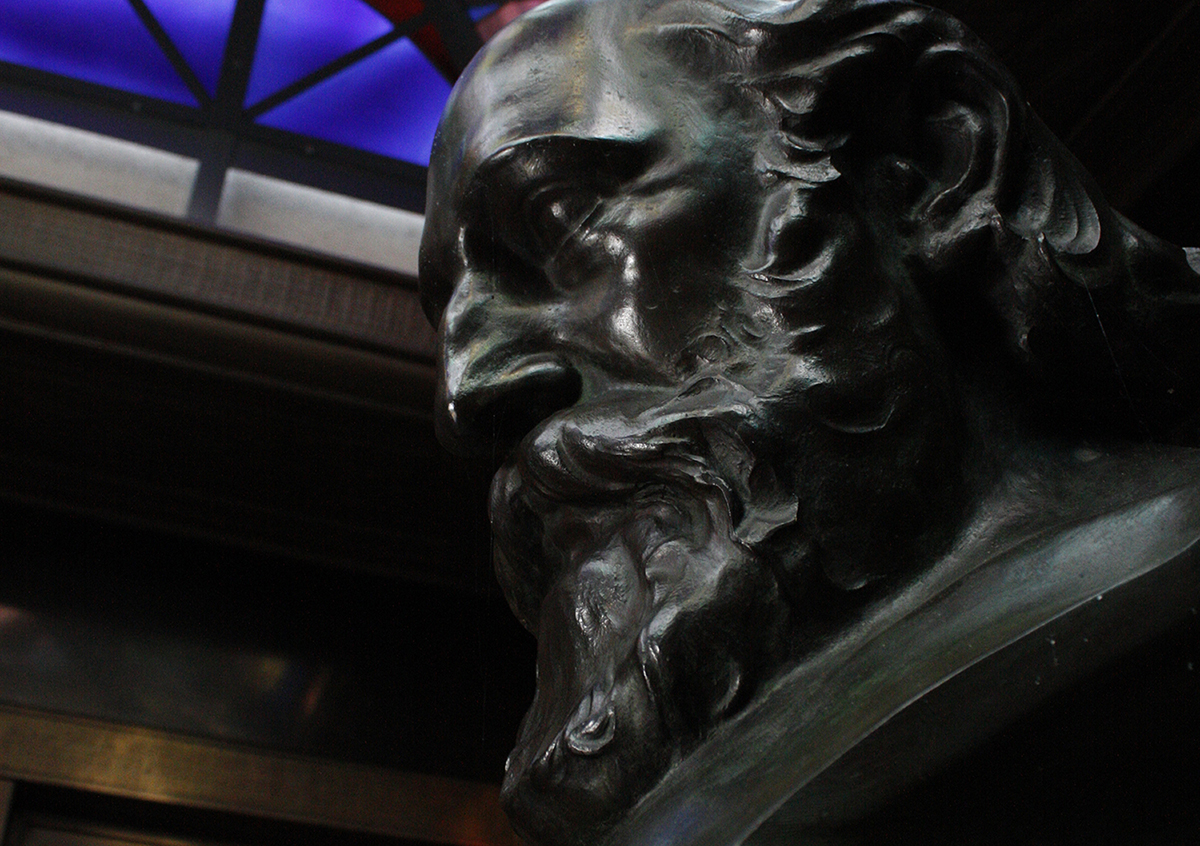
And this sculpture, should it be attributed to Bernini or Rodin?
To answer these questions and many others, Orange and the Rmn-Grand Palais have once again joined forces to propose a MOOC in 5 sequences.
The MOOC A brief history of art gives the keys to understanding works from the 16th to the 20th century, and solid tutorials to learn how to read a painting, a sculpture or even a monument. All this in a playful and practical form.
It will allow everyone to refresh their knowledge and rediscover the masterpieces of our artistic heritage. It can also be a solid base for all pupils and students preparing their art history exams.

Interesting project to see how to popularize art history to the public. The trailer is very successful with these photo montages!

Amuze.ch

Courage, delusion, obsession. In the museum you encounter conditions you have never sought. Because you did not know they existed. Everything starts with an idea. Give new thoughts the chance to inspire you.
Between stone and glass your journey of discovery begins. Every museum is a storage for objects and installations. And thus a collection of moments. Thousands are waiting for you in these houses.

You’re into art, but museums are too boring? In amuze’s Art Escape Room art is not dusty and complicated, but a challenge. Further information is available at www.amuze.ch

Modern times

Modern Times is a 1936 American silent comedy film written and directed by Charlie Chaplin in which his iconic Little Tramp character struggles to survive in the modern, industrialized world. The film is a comment on the desperate employment and financial conditions many people faced during the Great Depression — conditions created, in Chaplin’s view, by the efficiencies of modern industrialization.

Georges Méliès

Article on Vox

Georges Méliès, 8 December 1861 – 21 January 1938), was a French illusionist and film director who led many technical and narrative developments in the earliest days of cinema. Méliès was well-known for the use of special effects, popularizing such techniques as substitution splices, multiple exposures, time-lapse photography, dissolves, and hand-painted colour. He was also one of the first filmmakers to use storyboards. His films include A Trip to the Moon (1902) and The Impossible Voyage (1904), both involving strange, surreal journeys somewhat in the style of Jules Verne, and are considered among the most important early science fiction films, though their approach is closer to fantasy.

A Trip to the Moon. Film by Georges Méliès, 1902
The eclipse of the sun on a full moon. Film by Georges Méliès, 1907. Photo: Cinémathèque Méliès

Paul Virilio: Thinking speed

“Paul Virilio : Thinking Speed” a film by Stéphane Paoli (documentary 90 min / 2008 / La Générale de Production / ARTE France) In an unprecedented way, this dazzling story of Paul Virilio’s thought confronts the reflections of philosophers, political actors and journalists such as Rifkin, Yunus, Bender, Klein, Jean Nouvel.

https://www.youtube.com/watch?v=-zbdiFqbTnw&feature=emb_logo

“If time is money, speed is power…”

Progress and catastrophe are the obverse and reverse sides of the same coin (…) To invent the train is to invent the derailment, to invent the plane is to invent the crash (…) there is no pessimism in this, no despair, it is a rational phenomenon (…), masked by the propaganda of progress.

The Factory of Tales

Exhibition of the Ethnography Museum of Geneva, 17.05.2019–05.01.2020

Behind the scenes! Assembly of the exhibition “The Factory of Tales”

Once upon a time… Each of us knows stories beginning with those four words. From Finland to Greece, from Spain to the Alps, stories are part of our common heritage. It is this universe, at once very familiar and completely fantastical, that MEG explores in its new exhibition. When crossing the threshold, the public finds itself projected into a surprising atmosphere, where stories are lived as a sensory experience.

Museum of Communication, Bern

www.mfk.ch

The NEW Museum of Communication

Hilltop fires, smartphones and cyborgs.
More direct access than ever before: besides interactive displays, surprising objects and large-scale video screens, visitors to the Museum of Communication will now also be introduced to the fascinating world of communication by people made of flesh and blood, by our communicators.

A stagecoach, microchip implants or an original getaway car used in the robbery of the century? The new core exhibition examines all forms of communication, which has always connected human beings. But why do we communicate? And who do we communicate with? What is required for us to understand each other? The exhibition explores these fundamental questions in a playful manner whilst calling on its visitors to contribute their expert thoughts.
Numerous newly developed points of adventure await you. You can take part in a game of film karaoke and re-enact famous scenes, you can breach your opponent’s firewall in a hacking game or you can have a go at seeing through the data octopus’s game – you can try something different every time you visit the museum. At some point in the 2000 square metres of the exhibition you will surely meet one of our communicators. They will make each visit a personal and individual experience. How? Let us surprise you!

MuseumNext Podcast

Youtube Channel | Spotify Channel

MuseumNext (www.museumnext.com) is a Global Conference series on the future of museums.
Since 2009, our events have acted as a catalyst for inspiration, innovation and collaboration, bringing together those who are shaping the museum sector. These films share presentations from our conferences.

Spotify Channel
Creating the inclusive museum through storytelling

Exploring Ask

Youtube Channel

https://youtu.be/S_UzWSl0XLc
Jim Broughton, Head of International Engagement, The Natural History Museum London
Jim talked about the decisions museums must make in order to identify new areas for expanding their revenue-generating activities, without compromising either credibility or core purpose. He shared how the Natural History Museum had developed a strategic approach to evaluating and cultivating opportunities in order to accrue benefits that support its mission to challenge the way society thinks about its relationship with the natural world as much as they contribute funding towards its operations, programmes and research.
https://www.youtube.com/watch?v=9PLoORSrpZQ&feature=youtu.be
MICRO’s fleet of six-foot-tall museums are installed in high-impact public spaces from Rockefeller Center to NYC’s busiest public hospitals, reaching new audiences who would not otherwise have access to traditional museums.
The world’s first physically distributed museum, MICRO is a museum for everyone, everywhere. MICRO’s co-founder Charles Phillipp will share insights from MICRO’s unique approach to museum storytelling and design for new audiences in public spaces, an approach that ensures visitors of all ages and backgrounds can engage with complex topics from biology to physics, engineering and beyond.
https://youtu.be/X4OCUQRjcEw
Adam Reed Rozan,
Director, Programs & Audience Development,
National Museum of American History

Cultural organizations have historically shied away from taking on complex social issues through their collections and the stories they tell, choosing the safer path instead. But can they still afford to take the safer path? Many are choosing not to.
In this talk, Adam Rozan explores how cultural institutions are either preparing for or dealing with drastic, global changes. He highlights specific examples, particularly from the corporate world, and the lessons that all organizations can glean about what’s working or not.
https://youtu.be/LL8ZW3Vk-PA
Peter Gorgels, Internet Manager at Rijksmuseum in Amsterdam will share everything you always wanted to know about Rijkmuseum digital strategy and Rijksstudio, but were afraid to ask. This session will deep dive into some of the most successful projects on the digital side of museums, sharing the lessons that Peter and his team have learned along the way.
https://youtu.be/0Y1odsRw_BI
Lynda Kelly is Head of Web and Audience Research at the Australian Museum, Sydney. She has published widely in audience research and writes the popular blog ‘Audience Research’.
https://youtu.be/MkP2BTlotdw
https://youtu.be/Eq2qYXrSnIo
https://youtu.be/o5qw_XiPA3Q
https://youtu.be/gzGe6YCu-EM
https://youtu.be/dro9c9lBe7Q

Einstein – Hawking. The Universe Unveiled

Arte. Documentary by Michael Lachmann (UK, 2019, 52mn)

https://youtu.be/LDHxAyzac3Y

Could Einstein and Hawking together have reconciled relativity and quantum mechanics? This captivating documentary mirrors the discoveries of the two greatest minds in modern physics who revolutionized our vision of the Universe. This first part looks at the work of Albert Einstein (1879-1955).
Relativity, the Universe seen as a space-time continuum and attraction as a distortion of this continuum caused by stars and planets… This first part looks at the work of Albert Einstein (1879-1955). They are put into perspective by astrophysicists, in particular those of the Laser Interferometry Gravitational Wave Observatory (LIGO), which brings together 900 scientists from around the world. How do researchers today view the ideas of the Swiss-American genius?

https://youtu.be/564A-IPbQt0

Coronavirus: “A piece of Elsewhere in your home”

Maison d’Ailleurs – Yverdon-les-Bains (VD)

It’s time to take your capsule!
No, we’re not talking about a medicine, but rather about something whose effects could be similar to a vitamin shot: a bit of Elsewhere… at home!
“A Bit of Elsewhere in Your Home” is a micro-series of daily episodes based on culture, science fiction and good humour.
Because we all need it, and at the moment it’s difficult (or rather impossible) to go out to take care of our morale: we’ll bring you every day a little bit of Ailleurs, our Ailleurs, the one of the museum and its collections, and this, until April 30th at least.
So get ready to discover works, games, comics, books, objects… and to meet the partners and actors of the museum!
Hang on, we’re coming up fresh, motivated and disinfected, to make you laugh and think…
Let’s spread the culture virus!