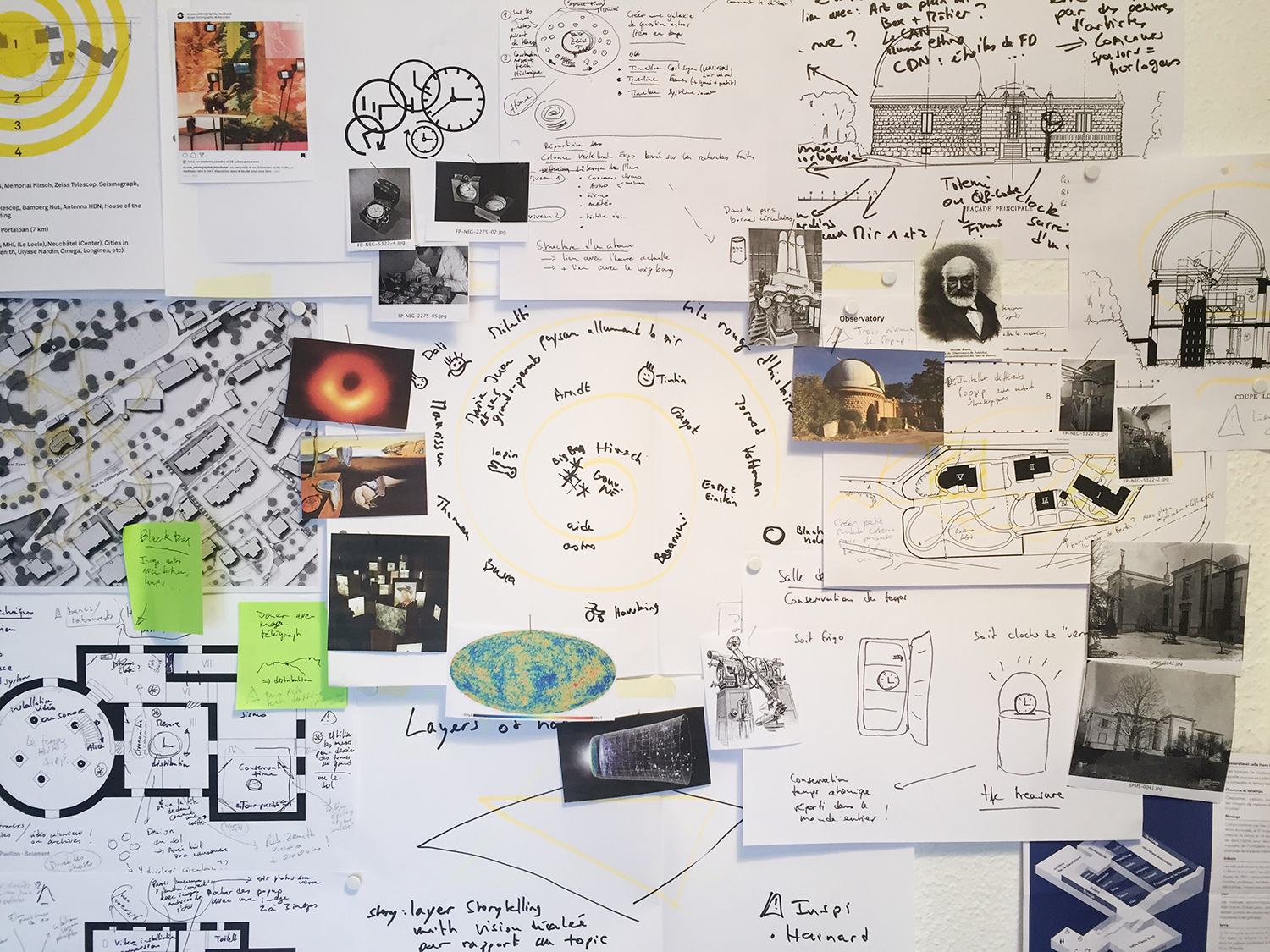
Activities for tourists with the topic of time in the Neuchâtel region

The Tourist Office of the canton of Neuchâtel has been developing several concepts for visits around the topic of watchmaking and time measurement for several years now. It will be necessary to work with them to promote the exhibition project at the Neuchâtel Observatory and include it in their programme.

Its offer is visible on their website via this link…

The city of La Chaux-de-Fonds developed the concept “How about exploring the world of watchmaking?”

The Franco-Swiss region between Besançon (historic watchmaking city with its mythical observatory) and La Chaux-de-Fonds has developed a concept of “Time measurement route”. It would be interesting to inscribe Neuchâtel with its observatory to link the two historical observatories because historically they worked together!
PDF file of the flyer.

Mark Twain, giant Sequoia

When “Mark Twain” was cut down in 1891, the giant Sequoia was 1,341 years old and measured 331 ft (100.9 m) high and 90 ft (27.4 m) in circumference at the base. Today a stump is all that remains of the once thriving tree that might have survived another thousand years. A cross section is on display at the American Museum of Natural History in New York; the curator at the time marked on its annual rings selected events of human history.

Photo Credit: Compton’s Pictured Encyclopedia and Fact Index (1947)

The Dangerous Game of Precision Timekeeping

From sundials and time balls to the six pips and smartphones, David Rooney charts the human quest to be bang on the dot of time.

Article on Vanity Fair by David Rooney

KGPA Ltd / Alamy Stock Photo

The bestselling author Marie Corelli, inspiration for the eccentric Lucia in E.F. Benson’s Mapp and Lucia novels, refused to change her clocks after the UK’s Summer Time Act was passed in 1916. She described people who went along with the practice of advancing time in summer months as “the sheep of humanity”. Instead, she believed in the sun and sailors. In Mapp and Lucia’s town of Tilling, real time was God’s time, and not to be trifled with.

But Corelli was wrong to hold that Greenwich Mean Time (GMT) was any truer than its hour-offset sibling. It is often claimed that the development of railways across the U.K. from the 1830s onwards led to the standardisation of time—to the use of GMT across the whole country, rather than the myriad local times kept by sundials on churches and public buildings in each town or village. It is true that railways ran better with one single time on their timetables. But local time clung on longer than we might assume. It was not until 1880 that a law was passed defining GMT as the U.K.’s standard, and in the end it was more about the Victorian temperance movement demanding liquor licensing with time restrictions than it ever was about railway timetables.
….

5 Strategies you need to know to keep your exhibit on budget

David Whitemyer
Original paper on MuseumNext>

Museum exhibits can be pricey. Whether it’s a permanent installation or a travelling exhibition, myriad influences can affect the cost. Image acquisition, AV hardware, shipping, materials, and more, can quickly throw a conservative project budget way off track, unless these aspects are carefully considered during the design process. 

Current estimates for the cost of museum exhibits are around $75 to more than $800 per square foot. This ridiculously wide range is due to a number of factors that differ from project to project, but which clearly make exhibit budget planning difficult, uncertain, and frightening. Whether your institution is flush with cash or on a shoestring budget, here are five proven methods for keeping your exhibition project costs in check:

Have a Contingency

A contingency is money set aside, to be used for increases in market costs or unforeseen items and services. For an exhibit project, it’s wise to have both a design contingency and a fabrication contingency. The design contingency can help fund great ideas that are born during the creative process, which might be financially more ambitious than the original program. A fabrication contingency will cover unpredictable costs related to things like travel, shipping and materials.

Reduce the Scope of Work

As the saying goes, “You can have anything, but you can’t have everything.” One of the fastest ways to get your exhibit costs in-line with your budget is to trim some of the fat. This could include implementing strategies such as reducing the project’s square footage or decreasing the number of trips or meetings.

Involve Fabricators Early

Whether you’ve hired a design-build firm or a sole exhibit design specialist, it helps to bring in a fabricator during the creative process. An exhibit fabricator can assess the physical design – from as early as the concept phase – to provide accurate cost estimates, material and finish suggestions, and coordinate ongoing museum architecture or general contracting work.

Communicate Honestly

This is a two-way street. Exhibit designers owe it to their museum clients to be frank if the project expectations and brainstorming ideas outweigh the project budget. Likewise, if during the creative process a designer is recommending solutions or technologies beyond your comfortable reach.  If this happens then you need to speakup, put on the brakes, and reevaluate what your budget can afford.

Avoid the Bandwagon

It’s easy to get caught up in high-tech trends, and to assume that your visitors expect theatrical immersion, multi user interactive tables, mobile apps, and AR or VR experiences. Although these things can enhance a museum exhibition and provide unique content delivery, they may not be realistic within a conservative project budget. Consider these costs at the beginning of the project and involve a media developer in the conversation so that s/he can share ideas and provide alternatives that fit within your budget.

It’s likely that following just one of these five strategies will help to keep your exhibit project on budget, but you may need to meld a few of them. Working with your partners, the project budget should be discussed and re-assessed from day one – from the kickoff meeting through to the project’s grand opening. Everyone must be aware of the budget, so that the entire team can be responsible for keeping it in check.
Positioning of Graphics in an exhibition

Glasgow Museums Display Guidelines
A practical Guide for Exhibitions

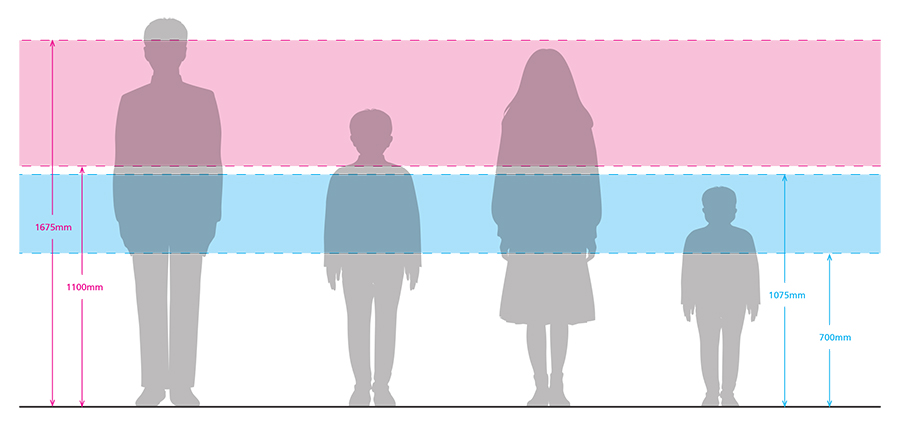
– Wall/screen-mounted graphics should wherever possible be positioned within the optimum viewing band [1100–1675mm]
– People with low vision may need to be within 75mm of a label in order to read it.
– Object labels should be located as near as possible to the object, so that both the object and the label can be seen from the same vantage point.
–Object labels should be positioned consistently next to the object.

Labels should be mounted at 90 degrees to the line of vision and as close to the viewer as possible. They should also be visible to wheelchair users.

– If label rails are used, don’t position the top of the label above the maximum recommended height.
– Position Braille labels at a consistent height and position, and on a horizontal or near horizontal plane (at between 600 and 700mm from floor level at the lefthand side) for the best reading angle.

Viewing bands for adults (pink) and pre-fives (blue).